Action research project
Communicating Smart Glasses
A study to design the communication of a new healthcare device
Action research project
Communicating smartglasses
A study to design the communication of a new healthcare device
The scenario
As part of the Master’s program in Medical-Scientific Communication and Health Services, the “Communicating Smart Glasses” project was launched, with the aim of promoting accurate information and informed use of smart glasses by people with visual impairments.
The project attracted so much interest that it led to the activation of a research grant by the Department of Neuroscience, Psychology, Pharmaceuticals, and Child Health (NEUROFABRA), co-funded by the sAu Research Center.
Smart glasses, now enhanced by artificial intelligence, are rapidly evolving from simple technological devices to tools with a potential impact on people’s health and autonomy. For this reason, it is necessary to question not only their performance, but also the ways in which they are designed, communicated, and introduced into care pathways.

The first model of smart glasses marketed by Google
The research falls within the “Health and Healthcare” area of intervention and aims to analyze smart glasses from an independent perspective, far removed from purely market logic. The goal is to understand usage contexts, leverage the input of patients, professionals, and associations, and promote communication based on scientific evidence, transparency, and health protection.
Intervention Area
Health and Healthcare

This project is part of the Master’s Degree in Medical-Scientific Communication and Health Services, a collaboration between the Department of Experimental and Clinical Medicine at the University of Florence and the sAu Research Center. The added value of the Master’s Degree is that it combines study and research with practical activities and concrete projects through proactive participation and ongoing support.
Call to action!

Do you work in an optical store?
Are you part of a company that produces smart glasses?
Are you part of an association for patients with visual impairments?
Have you had any experience using smart glasses as a medical device?
👉Write to direzione@sau-centroricerche.org
📣 Find out how to participate in the project and join our network!
The aim
The project was created to build a critical and interdisciplinary framework for how smart glasses with integrated artificial intelligence are communicated, both when aimed at people with normal vision and those with visual impairments.
Specifically, the project aims to analyze smart glasses not only as technological devices, but as tools that mediate relationships with the world—reading and interpreting texts, spaces, faces, and objects—and that, through communication, contribute to building specific ideas of “vision” and experience.
The aim is to promote the communication of smart glasses not as an accessory, but as a multisensory medium between people (visually impaired or not) and the world, in order to raise awareness among stakeholders (people with visual impairments, doctors, and companies) of the potential of this tool for agency and to promote dialogue between them.
The goals
- Map the stakeholders of a technology that supports the visually impaired (and thus the socioeconomic and cultural impact) beyond the world of those with vision loss;
- Analyze the communication of the main smart glasses devices on the market (starting with Ray-Ban Meta Glasses);
- Compare the promises with the actual technological possibilities and clinical and rehabilitation applications;
- Examine the differences between communications aimed at sighted users and those with visual impairments;
- Collect and integrate the perspectives of experts, professionals, users, and user associations;
- Identify critical issues, risks of over-promise, and areas for improvement;
- Develop guidelines for more informed, realistic, and inclusive communication of smart glasses as visual aids
The product
The project involves the creation of an Information Kit on Smart Glasses, intended as a thoughtful guide that highlights the promises, narratives, expectations, and actual limitations of the devices, with particular reference to their use as visual aids.
The Kit will be accompanied by a Participatory Communications Campaign aimed at sharing the Kit’s contents with key stakeholders (blind and visually impaired associations, vision rehabilitation centers, healthcare professionals, experts, and industry professionals) and by a final scientific publication documenting the methodologies, results, and best practices emerging during the project.
To ensure accessibility and the widest possible dissemination of the information content, the Kit, the Campaign, and the scientific publication will utilize digital tools and multimedia products.
The project has two core values that support and fuel each other: research and active action. The belief is that no study, however thorough, can be truly useful if it lacks concrete applications, and that, at the same time, an intervention not supported by a thorough understanding of the context in which it is intended could even be harmful. For this reason, the product aims to leverage the highest scientific expertise, making it available to the world of usus.
"Visual Fragility as Lens on Human Vision.
Smart Glasses and Beyond"
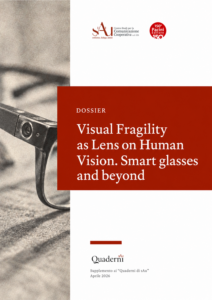
The sAu Research Center is publishing a dossier dedicated to the cultural, healthcare, social, and technological potential of smart glasses, serving as an in-depth exploration of the themes addressed in the “Communicating Smart Glasses” project.
The goal is to share the experiences and insights that emerged within the project community, fostering the transfer of knowledge from research to practice—and from practice back to research.
This dossier aims to help redefine the cultural role of smart glasses, encouraging a perspective that views them not merely as assistive devices or tools for accessing digital content, but as technologies capable of expanding and transforming the possibilities of vision and interaction with one’s environment.
The dossier will be presented at Floretina 2026—an international conference focused on research, surgery, and clinical practice regarding retinal diseases—which has partnered with the sAu Research Center for this editorial project.
The project community

Working Group



Master’s Organizing Committee
Prof. Francesco Liotta
Prof. Francesco Annunziato
Prof.ssa Betti Giusti
Prof. Felice Petraglia
Prof. Luca Toschi

Partner
Coming soon

In Italy, numerous organizations are already attempting to plan the healthcare of the future. These are valuable initiatives, and their results need to be compared and collated with a comprehensive and systemic vision to ensure they are not lost.
To enhance and disseminate these resources, we highlight some of the projects analyzed in our research.
Do you know of an initiative worth mentioning?
usARe
Fondazione Bruno Kessler
usARe is a project led by the Center for Digital Health and Wellbeing of the Bruno Kessler Foundation (FBK) in Trento and the Research and Development area of CertotticaGroup in Longarone to exploit the potential of smart glasses, making them evolve from a technological and fashion accessory into a true lifesaving tool.
Nursing Smart Care
Azienda USL Toscana Su-Est
Thanks to the donation of 40 smart glasses from Luxottica, the USL Toscana Sud-Est (South-East Tuscany Health Authority) has launched Nursing Smart Care, an innovative project designed for the local community that will allow family and community nurses to bring specialized skills directly into the homes of those they care for, reducing travel distances and response times and strengthening the local healthcare network.

Smart glasses: a technology yet to be invented
A chronicle spanning from retail spaces to healthcare settings
by Amos Tozzini
Augmented reality, in its various forms, is certainly not a new technology; however, in recent years, it has gained unprecedented momentum through a specific iteration: smart glasses. These are neither mere eyeglasses nor standard augmented reality headsets; rather, they function as a personal assistant—one you can converse with, that can perceive what you see, display what you wish to view, and provide personalized, location-based information in real time. Much like smartphones did in their day, these devices promise to revolutionize many of our daily habits.
But what exactly are these smart glasses? Where do they come from? When did they reach the market? What functions do they offer? And, above all, what impact might they have on our lives?
In this article, we present a summary of the first phase of our research, which focuses on the current state of commercially available smart glasses and their application in the context of managing visual impairments.