A New Communication Pact Between Governance and Citizens
A Dialogue on Participatory Democracy Practices
Date to be confirmed
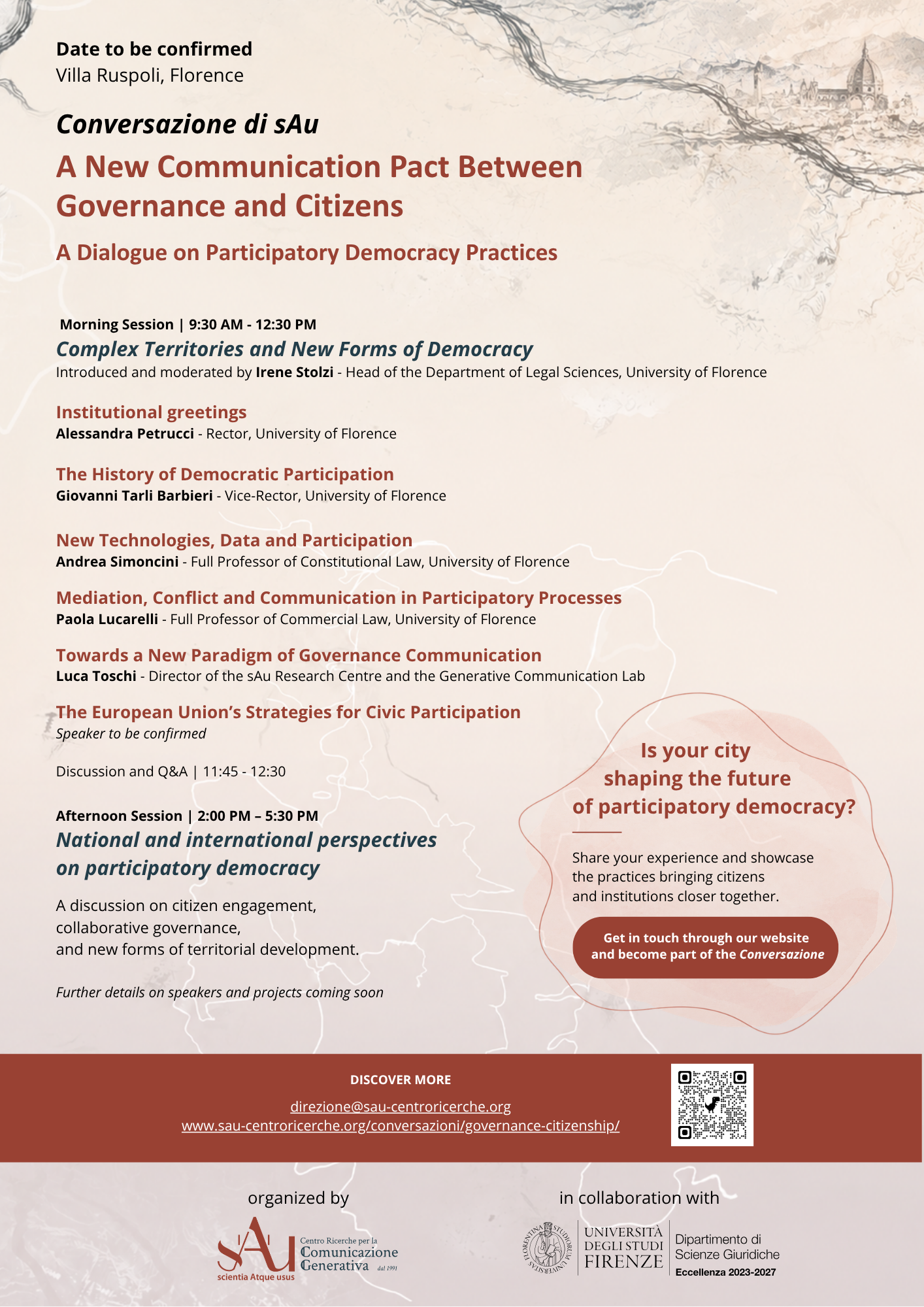
A day of discussion bringing together experts from different disciplines and representatives of institutions, local administrations, businesses and communities to explore new forms of participatory democracy and the role of communication in processes of engagement, listening and co-design.
The sAu Conversations are founded on the belief that academic research and the knowledge generated through practical experiences in local communities are equally valuable. Innovation emerges from bringing these different forms of knowledge into dialogue, connecting scientific perspectives with the solutions developed and tested by those working directly in the field.
Drawing on the experience of Viareggio Futura and other national and international practices, this Conversation aims to explore new models of participation and strengthen relationships between governance and communities.
When?
Date to be confirmed
Where?
Villa Ruspoli, Florence
About the sAu Conversations
The sAu Conversations are opportunities for discussion and dialogue designed to address an urgent issue affecting all socio-cultural, economic and political sectors: communication, as it is commonly understood and practised, is increasingly weakening collaboration and cooperation between the worlds of research, highly specialised professions and stakeholders.
This is an urgent issue that lies at the very heart of democracy, as well as the rights and responsibilities of every citizen.
What this sAu Conversation Explores
The event focuses on new forms of participatory democracy and on the role of communication in strengthening relationships between governance, citizens and local communities. Bringing together interdisciplinary research and practical experiences developed by institutions, local administrations, businesses and communities, the Conversation recognises both scientific knowledge and knowledge gained through practice as essential to innovation.
Starting from the experience of Viareggio Futura and drawing on national and international examples, the discussion will explore how participatory processes can be designed to encourage ongoing and inclusive citizen engagement. Particular attention will be given to listening, co-design and the shared implementation of initiatives, as well as to the role of digital tools and artificial intelligence in supporting participation. The event will also provide an opportunity to connect different experiences and perspectives, fostering a network of institutions, researchers, professionals and communities committed to developing more collaborative forms of governance.
Why this sAu Conversation Matters
Social complexity, technological change and declining trust in institutions call for new ways of understanding and practising democracy. Citizen participation cannot be reduced to occasional consultations: it requires continuous communication capable of creating the conditions for mutual understanding, active listening and collaboration.
Exploring the relationship between communication, participation and technology means asking how institutions and communities can build lasting relationships and develop shared responses to collective challenges. Developing more effective forms of participatory democracy means recognising the value of both academic research and the knowledge generated through practical experiences in local communities. Neither alone is sufficient: innovation emerges when different forms of knowledge, perspectives and experiences are brought into dialogue.
This sAu Conversation offers an opportunity to reflect on these questions, bringing together different experiences to explore how communication can support more effective participatory processes and contribute to new democratic practices.

What Happens Next?
This sAu Conversation is part of a broader research project that extends beyond the event itself. The contributions, experiences and insights gathered will feed into an editorial project within the sAu Community publishing series, connecting academic research with participatory practices developed in different territories.
Are you involved in a participatory democracy initiative? We would love to hear about your experience. Get in touch to share your practice and stay informed about the project and its future activities, of which this Conversation is just one part.
The sAu Conversation brings together researchers and experts from different disciplines, alongside representatives of institutions, local administrations, businesses and organisations engaged in participatory processes.
The event is organised into two sessions. The morning session, “Complex Territories, New Forms of Democracy,” explores interdisciplinary perspectives on democratic participation, governance and communication.
The afternoon session, “Work in Progress: Participatory Democracy Practices in Dialogue,” brings together national and international experiences, offering those directly involved in participatory initiatives an opportunity to share approaches, achievements and challenges.
Together, the two sessions foster dialogue between academic research and practical experience, recognising both as essential to developing new forms of participatory democracy.
Further details on speakers will be available online soon
Session 1 | Complex Territories and New Forms of Democracy


Professor Alessandra Petrucci
Rector, University of Florence
Institutional greetings

Professor Giovanni Tarli Barbieri
Vice-Rector, University of Florence
The History of Democratic Participation

Professor Andrea Simoncini
Full Professor of Constitutional Law, University of Florence
New Technologies, Data and Participation

Professor Paola Lucarelli
Full Professor of Commercial Law, University of Florence
Mediation, Conflict and Communication in Participatory Processes

Professor Luca Toschi

Coming soon
The European Union’s Strategies for Civic Participation
Session 2 | Work in Progress: Comparing Participatory Democracy Experiences
International Practices
Barcelona
Decidim: a platform for digital and deliberative democracy
Participation, ecological transition and active citizenship
Hamburg
Urban innovation and collaborative processes
Smart cities, civic participation and collaborative governance
National Practices
Participatory budgeting and collaboration agreements
Milan
Participation and digital innovation in large urban areas
Collaborative governance and local communities
Regional participatory processes and democratic innovation
The new Regional Observatory on Participation
Participatory democracy, collaborative governance and the role of communication in strengthening relationships between institutions and communities are central to the research and activities of sAu Research Center.
This section offers opportunities to explore these themes through articles published in Quaderni di sAu, research projects and practical experiences developed in collaboration with institutions and local communities.
Explore our projects, read our articles and access the Library for studies, sources and reference materials. Through GENESIS, you can further explore and connect the knowledge and experiences emerging from our research.

From the sAu Research Center Journal
How can citizen dialogue become an integral part of public decision-making?
In this new Quaderni di sAu article, we explore the experience of Nantes Métropole through an interview with Catherine Veyrat-Durebex and Ségolène Charles, highlighting the tools, methods and conditions needed to make citizen participation a concrete and lasting part of public action.
by Viola Davini
by Viola Davini
by Viola Davini

Open-Access Readings
La Mediazione, la fatica a comunicarsi e Utopia che già c’è
The text highlights the contrast between two approaches to communication and presents mediation as a faster, more human and collaborative alternative to ordinary court proceedings. Mediation does more than resolve conflicts: through trust and listening, it creates new resources, opportunities and relationships.
La scientia, l’usus e la vigna della comunicazione
The passage takes its title from an introductory chapter of the volume Il nuovo dono di Eva. La salute di genere come strumento di cura personalizzata, in which Professor Luca Toschi reflects on the relationship between scientia and usus and on the value of divergent questions as a driving force for more responsible research oriented towards the common good.

Generative Communication Projects
For years, we have been working to build new forms of relationships between governance and citizens through Generative Communication and participatory processes that engage communities, enhance local resources and help shape the future of territories.
Explore a selection of our community-building projects, collected in GENESIS, which brings together project materials and resources for further exploration.